Posted on — 1 Comment

Why Does My Dog Bark on Walks? A Context Log

Direct answer: A dog’s bark on a walk is a clue, not a one-word message. Note what appeared just before it, your dog’s whole-body signals, how the dog responded when distance or direction changed, and how long it took to return to their usual behavior. Compare several similar walks before drawing a pattern; an AI pet translator can offer a playful prompt, not a verified translation.

Recent consumer reporting points to more selective pet spending, not less care: the World Pet Association and BSM Partners’ October petLENS Pulse reported that nonessential spending fell below baseline in August while owners continued spending on pets. Morgan Stanley’s June 2026 analysis likewise described owners becoming more deliberate as costs rise. For everyday questions about a walk, a simple observation routine costs nothing and can make any later conversation with a trainer or veterinarian more specific.

What a bark can—and cannot—tell you

Verified behavior guidance: The American Kennel Club notes that barking and whining can have different causes, and should be read alongside body language and the situation. The RSPCA’s 2026 PAW Report also highlights continuing knowledge gaps around dog behavior and communication. Careful interpretation: A bark alone cannot establish whether a dog is excited, uncertain, frustrated, or reacting to a particular stimulus. Individual history, distance, movement, and what happens next matter.

What you notice What it may help you ask What to observe next
Barking begins when something approaches Does distance or approach direction matter? Record the trigger, approximate distance, and whether the dog can turn away.
Barking follows a sudden sound or movement Was the event unexpected or repeated? Note the sound or motion, the dog’s body posture, and recovery time.
Barking occurs around other dogs Does the response differ when there is more space? Choose a safe, quieter route and note the dog’s response without forcing a greeting.
The dog pauses, stiffens, or repeatedly tries to leave Is the current situation too much right now? Create distance and let the dog disengage; do not insist on getting closer.

A free four-step walk log

  1. Describe the scene. Write the location, time, weather if relevant, and what happened immediately before the bark. Use observable facts rather than labels such as “angry.”
  2. Look at the whole dog. Note posture, movement, tail and ear position, gaze, and whether the dog can sniff, respond to a familiar cue, or move away. One cue by itself is not a verdict.
  3. Make space, then observe. If the dog seems overwhelmed, calmly increase distance or change direction. Do not hold the dog near a trigger to “test” a theory.
  4. Record recovery and compare. Note how long it takes for ordinary walking and exploration to resume. Compare a few naturally occurring, similar situations; do not deliberately recreate a stressful event.

A compact note can be: “Quiet residential street, delivery cart rolled past at roughly one driveway away; three barks, body leaned forward, then turned with me; resumed sniffing after about a minute.” This is more useful than “my dog hates carts” because it preserves what was actually seen.

Using an AI pet translator carefully

If you use an AI Pet Translator, enter the scene and visible behavior as context, then treat its output as entertainment and a general daily-care reference. It cannot confirm your dog’s intent, assess safety, or replace a veterinarian or qualified trainer. For a related example of comparing a sound with context, see our guide to barking and lunging around other dogs.

For ordinary walks, properly fitted walking gear may help you keep a comfortable, secure hold while you observe. An optional breathable mesh harness and leash set is simply walking equipment; it is not a treatment or a way to change barking. Use equipment that fits your individual dog and follow its safety instructions.

Frequently asked questions

Does a dog’s bark on a walk always mean fear or aggression?

No. Barking can occur in many situations. Consider the trigger, the dog’s full body language, distance, and what happens when the dog has room to move away. A single bark does not establish an emotional state.

Should I let my dog approach the thing they are barking at?

Do not force an approach or greeting. If the dog appears uncomfortable, create space and let them disengage. For recurring or difficult reactions, ask a qualified trainer or veterinarian for individualized guidance.

How many walks should I log before deciding there is a pattern?

There is no fixed number. Record several naturally occurring situations and look for repeated context, distance, body cues, and recovery. Avoid staging encounters to collect more examples.

Can an AI pet translator tell me exactly what my dog means?

No. AI outputs are not verified translations. They can be used for entertainment or as a prompt to notice context, but they cannot diagnose a condition, establish intent, or replace professional care.

Sources and context

Posted on — Leave a comment

Does My Pet Like a Halloween Costume? Read the Body Language

Direct answer: A pet that freezes, scratches at clothing, lip-licks, yawns, or repeatedly tries to remove a Halloween outfit may be showing discomfort. No single signal proves what a pet feels, so pause, remove the outfit if the signs continue, and let the animal choose a simpler way to join in.

Halloween costumes are popular with U.S. pet owners this year: Rover reports that 60% of surveyed pet parents plan to dress a pet for Halloween. That is a participation signal, not evidence that every pet enjoys wearing a costume. The useful question is not whether a photo looks cute, but how the individual animal moves and behaves before, during, and after a brief try-on.

What the current evidence says

Verified demand signal: Rover says its October 2026 survey of 1,000 U.S. pet parents found 60% planned to put a pet in a costume; 30% delayed choosing or purchasing one until near Halloween. These are self-reported plans from a company survey, not a measure of how comfortable the pets were.

Practical safety guidance: The American Animal Hospital Association (AAHA) advises choosing clothing that does not restrict movement, breathing, vision, or hearing, and notes that refusal to move, scratching or biting at the outfit, lip-licking, and yawning can be signs to stop. This is general guidance, not a diagnosis.

Careful interpretation: A yawn, stillness, or scratch can have more than one explanation. Compare it with your pet’s normal behavior and the full scene; do not label a single gesture as a definite emotion or a translation.

Read the whole scene, not just the costume photo

What you observe What to check Low-pressure response
Your pet walks and settles as usual Does the outfit stay clear of the face, legs, and tail? Can your pet sit, turn, and lie down normally? Keep the first session brief and supervised; end it while your pet is still comfortable.
Freezing, crouching, or refusing to move Is the clothing new, tight, noisy, warm, or unfamiliar around the head or feet? Remove it and give your pet space. Do not pull, coax, or hold the animal in place for a photo.
Scratching, biting, or repeatedly pawing at the outfit Check for rubbing, dangling pieces, trapped claws, or a fit that shifts when the pet moves. Take the outfit off. Try a simple collar decoration only if your pet is comfortable with it, or skip dress-up.
Lip-licking, yawning, turning away, or moving off Note what happened immediately before the signal and whether it repeats or appears with other changes. Pause the interaction and allow the pet to leave. Treat the pattern as a reason to reduce pressure, not as a certain translation.

A simple try-on and observation workflow

  1. Start without the outfit. Note your pet’s ordinary posture, movement, and willingness to approach in a quiet familiar room.
  2. Offer, do not impose. Let the pet sniff the costume. If they move away, stop there.
  3. Use a short, supervised try-on only if accepted. Keep the face, ears, legs, tail, and breathing unobstructed. Check that the pet can walk, sit, turn, and lie down.
  4. Watch for a cluster and a change from baseline. Record the time, outfit piece, duration, movement, vocalizations, and whether the pet chose to approach or leave.
  5. End at the first repeated discomfort signs. Remove the clothing calmly and offer a familiar alternative, such as a photo beside the costume rather than in it.
  6. Keep Halloween itself separate from the costume test. Doorbells, visitors, noise, and open doors create different demands. AAHA recommends a quiet space away from the door for pets unsettled by Halloween activity.

For more context-first interpretation, see our guides to the AI Pet Translator topic center, dog barking at Halloween visitors, cats hiding when Halloween guests arrive, and noticing when a cat wants an interaction to pause. AI pet-translator outputs are for entertainment and general daily-care reference; they cannot establish a pet’s exact feelings or replace veterinary guidance.

Optional everyday-walk gear: If you and your dog choose a quiet outdoor walk instead of wearing a costume, you can review this breathable mesh harness and leash set as ordinary walking equipment. It is not a costume or a behavior solution; check the product sizing and your dog’s comfort before use.

FAQ

How can I tell if my dog dislikes a Halloween costume?

Look for a change from your dog’s usual behavior, such as freezing, refusing to move, repeatedly scratching or biting at the outfit, or trying to get away. One signal alone does not prove an emotion; pause and remove the costume if discomfort signs repeat.

Is yawning always a sign that a pet is stressed?

No. Yawning has multiple possible contexts. Consider what happened just before it, whether it repeats, and whether it appears with other changes such as turning away or trying to remove clothing.

Should I make my pet keep a costume on for a photo?

No. Keep any try-on brief and supervised, and stop if your pet resists or shows repeated discomfort. A photo beside the outfit or a simple pet-safe accessory may be a better choice, and skipping dress-up is fine.

Can an AI pet translator tell me whether my pet likes the costume?

No tool can confirm an animal’s exact internal state from one sound or image. Treat AI output as entertainment and general daily-care reference, then rely on the whole scene, your pet’s baseline, and their ability to move away.

Sources and context

Posted on

Why Does My Dog Stare While I Eat? A Mealtime Context Log

Direct answer: A dog watching you during a meal may be following food or routine cues, asking for attention, waiting for a familiar response, or simply checking in. A stare alone cannot tell you which. Note what happened just before it, the dog’s whole-body posture, and what happened next.

What a meal-time stare can and cannot tell you

Verified context: Dogs can use gaze in ordinary communication and may watch people around food, routines, or expected activities. A learned pattern can also form when a stare is followed by food or attention. These are possibilities, not a literal translation of one look.

Careful interpretation: Compare the setting and the rest of the dog’s body. A loose posture and brief glances are different observations from a fixed, hard stare paired with a stiff body. Neither eye contact nor a wagging tail should be interpreted alone.

What is happening What to record Useful next step
You are holding or serving food Food visible, meal timing, distance, posture, and whether the dog looks between you and the food Record the sequence; do not assume the dog is asking for a specific item or feeling.
The dog watches after a familiar household cue Whether you sat down, opened packaging, moved toward the kitchen, or used a usual meal-time phrase Compare the same cue on another ordinary day.
The dog glances over while resting nearby Loose versus tense posture, soft versus fixed gaze, and whether the dog soon looks away or settles Give the dog room to disengage; log the whole scene rather than assigning a single emotion.
The gaze becomes fixed and the body stiffens around food or a valued item Distance, item present, muscle tension, freezing, growling, or other change Do not reach for the item or stare back. Calmly create space and seek qualified veterinary-behavior guidance if this pattern recurs.

A five-meal MEAL observation log

  1. M – Moment: Note the time, meal stage, food visible, and what the people in the room were doing immediately before the stare.
  2. E – Entire body: Record whether the dog looked loose or stiff, the head and ears, tail position, mouth, and any movement. Describe what you saw rather than writing an emotion as a fact.
  3. A – Action: Write what the dog did next: looked away, moved closer, sat, vocalized, ate its own meal, or settled. Include the owner’s response without changing the routine just to test the dog.
  4. L – Later comparison: Repeat on several ordinary meals. Look for a consistent cue-and-response pattern, not a one-off result.

If you want to change a learned begging routine, choose a calm, consistent alternative such as settling on a mat away from the table, and reward that behavior according to a plan that suits your household. Do not punish, corner, or force eye contact. Where there is a hard stare, stiffness, freezing, or guarding, prioritize distance and qualified help rather than trying to train through the moment.

Optional mealtime convenience

If your goal is simply to keep your dog’s own feeding schedule consistent, the Smart WiFi Automatic Pet Feeder is an optional convenience product. It is not a behavior treatment, does not explain a stare, and is not a substitute for observing the situation or asking a veterinarian about a new behavior change.

Try the context, not a guaranteed translation

Use the AI Pet Translator as an entertainment and general daily-care reference: include the meal context, timing, body posture, and what happened next. Its output is a prompt for observation, not proof of what a dog means or a veterinary assessment. For a related routine example, see how a dog’s breakfast timing can shift around a household clock change and how to observe a two-way attention pattern.

FAQ

Does a dog stare at me while I eat because it is hungry?

It may be following food cues or a learned mealtime routine, but staring alone does not establish hunger. Record meal timing, food visibility, and what the dog does next.

Does eye contact mean my dog loves me?

Not by itself. Gaze can occur in several contexts, including attention, learned cues, food, and social interaction. Read it with posture and the surrounding scene.

Should I stare back or take food away?

No. Avoid challenging a fixed stare, especially if the dog is stiff or guarding food. Do not reach in; calmly create distance and seek qualified help if the behavior recurs.

Can an AI pet translator tell me exactly what my dog means?

No. An AI pet translator cannot guarantee a literal translation, diagnose a condition, or replace veterinary care. Treat its output as an entertainment and general daily-care reference, then compare it with repeated observations.

Sources and context

This evidence-informed evergreen guide is for observation and everyday care only. It does not diagnose behavior or health conditions, and an AI pet translator is not a substitute for veterinary advice.

Posted on — Leave a comment

Why Is My Senior Dog Slipping on Hardwood Floors?

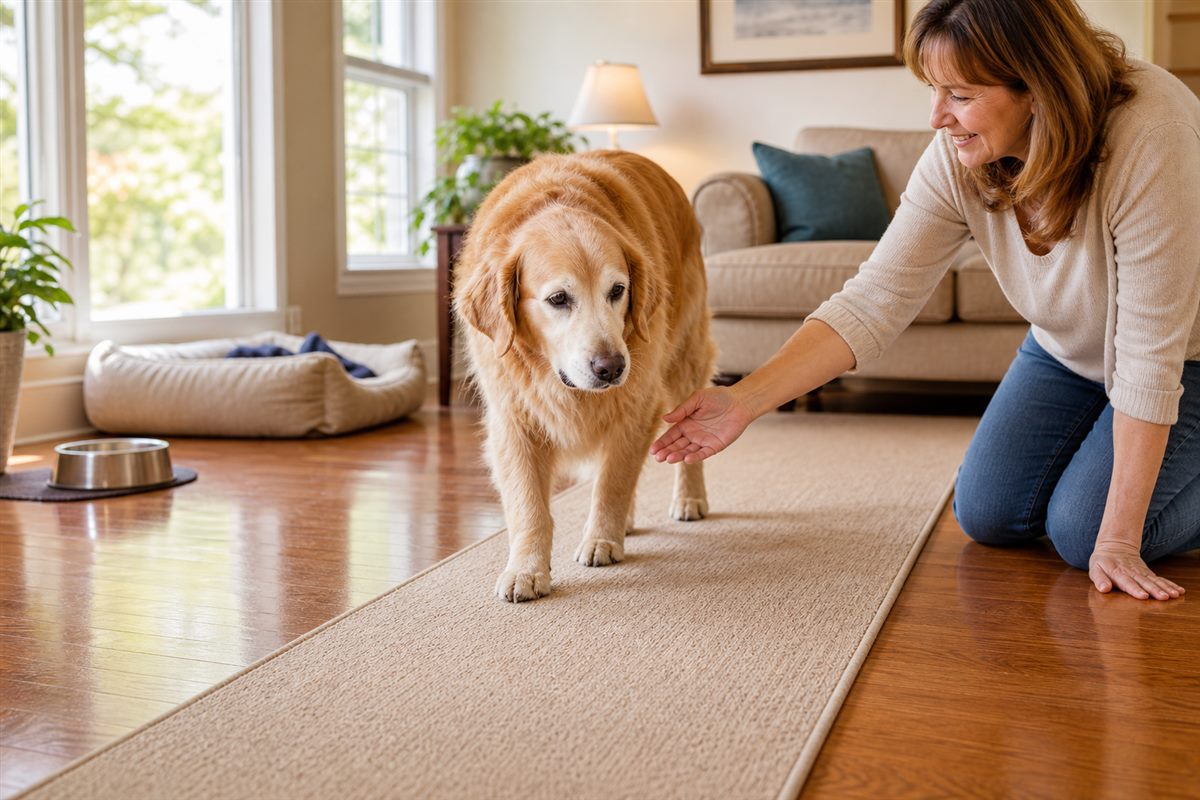
Senior golden retriever walking on a non-slip runner over a hardwood floor

If your senior dog has started slipping on hardwood floors, they may not be lazy, stubborn, or afraid to walk. Smooth flooring can become difficult to navigate when aging affects strength, balance, joints, vision, or confidence.

The kindest first step is simple: give your dog a stable path through the home and arrange a veterinary check if the change is new, frequent, or painful.

Why Do Older Dogs Slip on Wood Floors?

A senior dog may struggle to grip a smooth floor for several reasons:

  • Reduced muscle strength, especially in the back legs
  • Joint stiffness or discomfort
  • Arthritis or another orthopedic condition
  • Long nails or excess fur between the paw pads
  • Reduced balance, coordination, or vision
  • Recovery after an injury or surgery
  • Anxiety after a previous fall

Osteoarthritis can cause stiffness, gait changes, difficulty rising, reduced activity, and trouble using stairs or jumping. Cornell University College of Veterinary Medicine includes non-slip rugs and ramps among the lifestyle changes that may help dogs with osteoarthritis manage daily mobility.

Slipping is not a diagnosis by itself. A veterinarian can help identify whether pain, arthritis, weakness, a neurological problem, or another condition is contributing to the change.

How to Help a Senior Dog Stop Slipping

1. Create a Continuous Non-Slip Path

Place secure runners, rugs, or non-slip mats along the routes your dog uses most:

  • Bed to water bowl
  • Bed to the door
  • Hallway to the family room
  • Food area to the resting area
  • The approach to stairs, ramps, or exterior doors

Avoid leaving large gaps of exposed hardwood between mats. A dog may stop at the edge if the next safe surface feels too far away.

Choose materials that:

  • Stay flat without curling at the edges
  • Do not slide when your dog pushes against them
  • Provide traction while standing as well as walking
  • Are easy to clean
  • Have a low profile to reduce tripping

Test each mat yourself by pressing and pushing it with your foot before asking your dog to use it.

2. Keep Nails and Paw Hair Maintained

Overgrown nails can change how a dog places their feet. Excess fur between the paw pads may also reduce contact with the floor.

Ask a groomer or veterinarian to show you an appropriate nail length and safe paw-pad trim for your dog. Do not cut nails or fur aggressively, especially if your dog is uncomfortable standing.

3. Make Standing Up Easier

Place a non-slip surface beside your dog’s bed so all four paws have traction when they rise. Consider a supportive, low-entry bed that does not require stepping over a high edge.

If your dog repeatedly struggles to stand, speak with your veterinarian rather than relying only on a new bed or floor covering.

4. Reduce Unnecessary Jumping

Move frequently used items to the same level when possible. A stable, appropriately sized ramp may help some dogs reach a couch, bed, porch, or vehicle without jumping.

A ramp should be wide, secure, low enough in angle, and covered with a genuinely grippy surface. Introduce it gradually with calm encouragement. Never pull or force a frightened dog onto it.

5. Slow Down the Daily Routine

Give your senior dog time to stand, turn, and choose their footing. Avoid calling them excitedly across a slippery room or rushing them at doors.

Place food, water, and resting spaces within a comfortable distance. Small changes to the home can reduce both physical effort and fear.

What Should You Avoid?

  • Loose towels or blankets that slide or bunch up
  • Small mats that move under the dog’s weight
  • Adhesives that may damage floors or expose pets to unsafe materials
  • Paw products with unclear ingredients or unrealistic claims
  • Forcing a dog to walk after they show pain or fear
  • Assuming frequent falls are simply a normal part of aging

When Should You Call a Veterinarian?

Arrange veterinary care if slipping appears suddenly or is accompanied by:

  • Pain, crying, or sensitivity to touch
  • Limping or a noticeable gait change
  • Difficulty standing up
  • Dragging, crossing, or knuckling of the paws
  • Repeated falls
  • Weakness on one side
  • Reluctance to walk, use stairs, or eat
  • A recent injury or surgery
  • Changes in behavior or bathroom habits

Seek urgent veterinary advice if your dog suddenly cannot stand, collapses, appears severely painful, or rapidly loses control of their legs.

The American Animal Hospital Association emphasizes that senior care may include environmental modification alongside medical, behavioral, and pain-management support. Home changes are helpful, but they should not replace an examination when a dog’s mobility changes.

A Safer Path Is an Act of Care

Your dog has walked beside you for years. As they grow older, a familiar hardwood floor may begin to feel uncertain.

You do not need to redesign the entire house in one day. Start with one secure path between the places that matter most. Watch how your dog moves, make adjustments, and ask your veterinarian for help when something does not look right.

Sometimes love looks like a rug that does not move, a bowl placed a little closer, and the patience to let an old friend walk at their own pace.

Explore practical aids for senior and recovering pets: Mobility & Recovery at Elongbuy Pet

Frequently Asked Questions

Why is my senior dog suddenly slipping?

Sudden slipping may be related to pain, injury, weakness, balance changes, or another medical problem. Add temporary traction and contact your veterinarian, especially if your dog is limping, falling, or struggling to stand.

What flooring is best for an old dog?

A secure, low-profile surface with reliable traction is usually easier than smooth wood or tile. Non-slip runners and rugs can create safe routes without replacing the entire floor.

Do dog socks stop slipping?

Some dogs tolerate traction socks, but fit, rotation, moisture, and comfort can be problems. Floor-based traction is often easier to maintain. Check your dog’s paws frequently if using wearable products.

Can long nails make a dog slip?

Long nails may affect paw placement and traction. Ask a veterinarian or groomer about safe nail and paw-hair maintenance for your dog.

Should I use a harness to help my senior dog?

A properly fitted support harness may assist some dogs with weakness or recovery, but it must distribute weight safely and should not cause chafing or interfere with urination. Ask your veterinarian for guidance if your dog needs regular lifting support.

Editorial Sources

This article is for general education and daily-care reference. It does not diagnose disease or replace veterinary advice.